
225.6K
Downloads
44
Episodes
Thought leadership on all things supply chain from the MIT Center for Transportation and Logistics.
Episodes
Aug 15, 2023
Aug 15, 2023
36 min
"Hope is not a strategy."
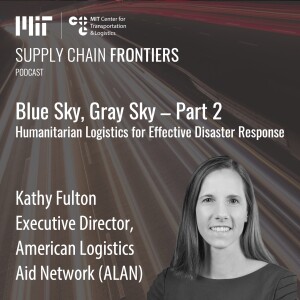
In this episode, we are joined by Kathy Fulton, Executive Director of the American Logistics Aid Network (ALAN), who discusses her work connecting private-sector resources with disaster response needs: a "gray sky" response, after a disaster hits. For instance, if a supplier has excess food they need to offload, ALAN will connect them with a warehouse with the capacity to accept the delivery. ALAN forges partnerships between various players in the supply chain as well as between the public and private sectors, which, along with information sharing among all parties, are critical to fostering collaboration in order to respond effectively to a disaster and to strengthen future disaster preparedness.
Hosts: Tim Russell & Lauren Finegan
Executive Producer: Benjy Kantor
Marketing Writer & Producer: Dan McCool
Sound Editor: David Benjamin Sound
Audio Engineer: Kurt Schneider
Jul 31, 2023
Jul 31, 2023
30 min
In the wake of a disaster, restoring supply chains can be critical in assuring that the most vital needs of affected communities are met.
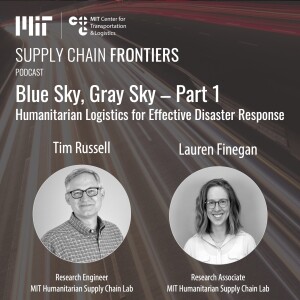
In this episode, Tim Russell and Lauren Finegan of the MIT Humanitarian Supply Chain Lab discuss the fundamentals of humanitarian logistics and disaster response—including how to best build resilient communities, how the public and private sectors can work together for optimal disaster response, and how their research and work helps inform and strengthen disaster response work worldwide.
Learn more about the work of the MIT Humanitarian Supply Chain Lab.
Host & Executive Producer: Benjy Kantor
Marketing Writer & Producer: Dan McCool
Sound Editor: David Benjamin Sound
Audio Engineer: Kurt Schneider
May 11, 2023
May 11, 2023
45 min
Supply chain design has traditionally been conducted with only one dimension in mind: cost minimization. The conventions of supply chain design date largely from the 1990s. But major technological strides have been made in the years since, allowing for much more complex considerations to be taken into account. So most companies, by using this obsolete approach, are putting themselves at a competitive disadvantage.
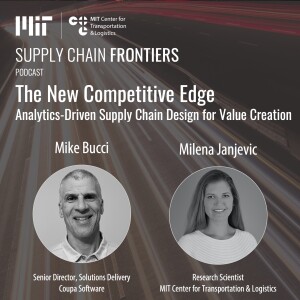
Today's episode features Milena Janjevic, Research Scientist at the MIT Center for Transportation & Logistics, and Mike Bucci, a Senior Director for Solutions Delivery at Coupa Software. Milena and Mike discuss how they're seeing the field evolve, touching on four big opportunities to take supply chain design from a cost-minimization exercise to an engine to drive value creation:
- Extending the scope of supply chain design
- Incorporating tactical decision making
- Accounting and planning for risk and resilience
- Adapting new technologies and business models
For more, learn about the Supply Chain Design Initiative at the MIT Center for Transportation & Logistics.
Host: Arthur Grau
Executive Producer: Benjy Kantor
Marketing Writer & Producer: Dan McCool
Sound Editor: David Benjamin Sound
Nov 2, 2022
Nov 2, 2022
24 min
Truckload transportation services procurement is costly and time-intensive. These months-long procurement events typically result in thousands of contracts between shippers and carriers. The contracts cover each of the shipper’s product distribution lanes or origin-destination pairs.
Due to truckload supply and demand uncertainty, shippers often adopt a coverage strategy to secure contracted capacity on combinations of lanes to meet expected demand. However, this strategy leads to unnecessary costs and inefficiencies. We find that many lanes never end up being utilized. We refer to contracted lanes on which no business materializes as "ghost lanes."
On today’s episode, research scientist David Correll speaks with Tilburg University postdoctoral researcher Angela Acocella Ph.D. '22 on the hidden costs and possible reasons for ghost lanes.
Read more. https://ctl.mit.edu/pub/workingpaper/hidden-costs-not-so-friendly-ghost-lanes

Aug 11, 2022
Aug 11, 2022
53 min
This episode marks the second installment of research scientist David Correll speaking with the 2021–22 MIT CTL military fellows: US Army Col. Joe Parker, Lt. Col. Brian Young, and Louisiana National Guard Lt. Col. Stephen J. Luebbert.
Today’s conversation is all about empathetic leadership. Parker, Young, and Luebbert discuss how leading teams in high-stress environments like military combat requires empathy and humility. They revisit continual process improvement, applying the "red cell" strategy, and the after-action review process. Sharing their personal stories, they portray how effective leaders listen to those around them and enthusiastically welcome positive and negative feedback to make sound decisions, foster team cohesion, and achieve peak performance.
Since 2007, MIT CTL has hosted three US military officers each year for a course of academic study that parallels the MIT ten-month Supply Chain Management master’s program. Sponsored by the United States Army War College’s Senior Service College Fellows (SSCF) program, top officers are selected to attend.
CTL Military Fellows accompany the more than 80 other global business professionals in the program’s curriculum and develop strong analytical, change management, and leadership skills. Their work includes an in-depth research project.
Apr 26, 2022
Apr 26, 2022
31 min
In today’s episode, research scientist David Correll speaks with the 2021–22 MIT CTL military fellows: US Army Col. Joe Parker, Lt. Col. Brian Young, and Louisiana National Guard Lt. Col. Stephen J. Luebbert. The fellows discussed their experiences in the military and the MIT SCM program.
For written and downloadable transcripts visit ctl.mit.edu
Their conversation explores the differences and similarities between private-sector and military supply chains in strategy, leadership, and on-the-ground implementation. We learn how in the private sector, cost and efficiency drive supply chain decision making, whereas in the military portability, safety, and redundancy may be seen as primary drivers. The episode ends with some ideas about how the government and private sector could collaborate more.
Since 2007, MIT has hosted three US military officers each year for a course of academic study that parallels the MIT ten-month Supply Chain Management master's program. Sponsored by the United States Army War College’s Senior Service College Fellows (SSCF) program, top officers are selected to attend.
CTL Military Fellows accompany the more than 80 other global business professionals in the program’s curriculum and develop strong analytical, change management, and leadership skills. Their work includes an in-depth research project.
Feb 11, 2022
Feb 11, 2022
29 min
Join MIT Global SCALE Connect for an in-depth conversation with Paul Granadillo, SVP Global Supply Chain at Moderna. MIT Professor Yossi Sheffi speaks with Paul about how the pandemic vaccine response reshaped manufacturing, business, and supply chains at Moderna.
Mr. Granadillo shares his professional experiences learned from joining the company during a time of growth. He describes some of the methods Moderna uses to meet its logistics and production requirements during the ramp-up to a global Covid-19 vaccine rollout.
Recorded at MIT SCALE Connect, the winter education convening of the MIT Global SCALE Network.
Dec 8, 2021
Dec 8, 2021
29 min
Bottleneck analysis aiming to increase asset productivity has commonly been applied inside the four walls of production and distribution facilities. The pandemic disrupted global supply chains with dramatic shifts in demand and constraints in supply with cascading effects. Shippers then dynamically shifted traditional origin-destination patterns causing stress on the networks of logistics service providers.
As a result, bottlenecks in the global movement of goods continue to emerge in new locations and for longer durations. Today we speak with Jarrod Goentzel, director of The Humanitarian Supply Chain Lab about how they study dramatic disruption of supply and demand during disasters and has created tools to rapidly identify bottlenecks and dynamically determine interventions to increase flow.
We discuss their conceptual approach and simulation models using the fuel supply chain in the U.S. with use cases around recent disruptions such as the Colonial Pipeline cyberattack and Hurricane Ida. For more information on the approaches visit: https://humanitarian.mit.edu/research/ and to learn more about joining the MIT CTL Supply Chain Exchange visit: https://ctl.mit.edu/outreach
Sep 29, 2021
Sep 29, 2021
38 min
Earlier this year, MIT CTL's David Correll spoke with over-the-road truckers about their experiences in order to shed light on why it is that U.S. truckers appear to be both scarce and underutilized at the same time.
During the year, Dr. Correll oversaw three MIT SCM master's capstones that addressed truck driver utilization and retention in contrast to shipper and receiver policies and practices. These were completed as part of the MIT FreightLab's Driver Initiative.
In today's episode, we hear how a variety of factors influence driver utilization, and how they may impact the widespread driver shortage currently experienced in the U.S. David's guests offer solutions that shippers, warehouse managers, dispatchers, and their companies can implement to improve.
Download a transcript of this episode.
Read the capstones covered in this episode.
Diving Deep into the Determinants of Driver Dwell Authored by: Michelle Catherine Roy, Leora Reyhan Sauter
Goldilocks and the Three Dispatchers: Quantifying the Impact of Dispatcher Management on Truck Driver Performance Authored by: Danielle Procter, Paulo Sousa Jr.
Automation of Warehouse Decision Making Authored by: Roogers Marino, Zeyu Wu
Aug 11, 2021
Aug 11, 2021
23 min
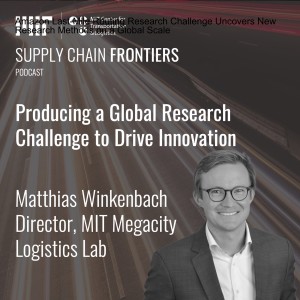
The MIT Center for Transportation & Logistics (MIT CTL) and Amazon engaged with a global community of researchers across a range of disciplines, from computer science to business operations, to supply chain management, challenging them to build data-driven route optimization models leveraging massive historical route execution data and machine learning models.
While we congratulated the winning teams and all participants in the news, Dr. Matthias Winkenbach joins today's Frontiers to share some insights and outcomes that the production of a research challenge brought about.
He speaks about how convening researchers from across all levels of academia and supplying rich data and a compelling problem, may drive more new research in areas of inquiry that are sparsely published on.
Learn more about the Challenge: https://routingchallenge.mit.edu/
Learn more about the Megacity Logistics Lab: https://megacitylab.mit.edu/